Nedtællingen | counter | timer Værktøjer!
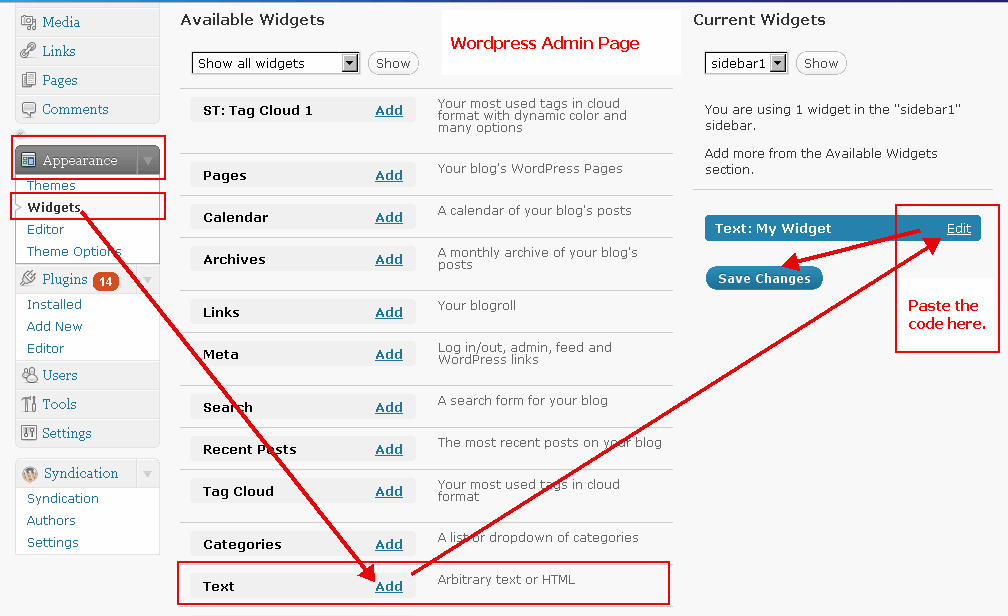
Tryk på knappen Kopier og indsæt i din blog eller hjemmeside.
(Du kan skifte til HTML-tilstand, når du sender ind i din blog. Eksempler: WordPress Eksempel, Blogger Eksempel)
Quantity theory of money - Wikipedia The quantity theory of money (often abbreviated QTM) is a hypothesis within monetary economics which states that the general price level of goods and services is directly proportional to the amount of money in circulation (i e , the money supply), and that the causality runs from money to prices
Quantity Theory of Money (With Diagram) - Economics Discussion In its simplest form, it states that the general price level (P) in an economy is directly dependent on the money supply (M); P = f (M) If M doubles, P will double If M is reduced to half, P will decline by the same amount This is the essence of the quantity theory of money
quantity theory of money - Encyclopedia Britannica quantity theory of money, economic theory relating changes in the price levels to changes in the quantity of money In its developed form, it constitutes an analysis of the factors underlying inflation and deflation Learn more about inflation, interest rates, and economic policy
Quantity Theory of Money: Principles of Macroeconomics. . . The quantity theory of money is an economic theory that posits a direct relationship between the quantity of money in an economy and the general price level It states that changes in the money supply lead to proportional changes in the price level, assuming other factors remain constant
Quantity theory of money | Business and Management - EBSCO The quantity theory of money is an economic model that suggests changes in the money supply in an economy produce proportional changes in prices A higher supply of money results in higher prices (inflation), whereas a lower supply leads to lower prices (deflation)
The Quantity Theory of Money The - Institute of Economic Affairs THE QUANTITY THEORY OF MONEY: A NEW RESTATEMENT TIM CONGDON First published in Great Britain in 2024 by The Institute of Economic Afairs 2 Lord North Street Westminster London SW1P 3LB in association with London Publishing Partnership Ltd